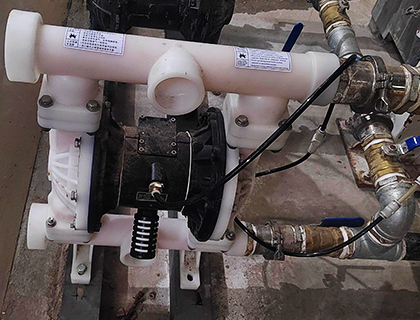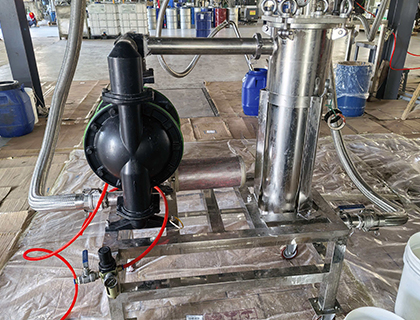
Pneumatic Diaphragm Pump for Sludge Dewatering
Case 2022-06-14
Application:Transfer settled sludge and excess biological sludge to plate-and-frame/filter presses for mechanical dewatering, achieving sludge volume reduction and compliant discharge
Site Operating Conditions
Medium: Municipal excess biological sludge and mixed sedimentation sludge, containing sand, suspended solids, and fine particulate impurities.
Sludge Concentration: Highly viscous slurry with a high moisture content of 95%–98%.
Transfer Specifications: Vertical lift of approx. 3–5 m and horizontal distance of 20 m to the filter press room on the second floor.
Pressure Requirements: Requires stable pressure ramp-up during feeding and high-pressure holding in the later stage to ensure dense filter cake formation.
Duty Cycle: Intermittent batch feeding. Each filtration cycle lasts 2–3 hours, operating in multi-batch loops throughout the day.
Key Challenges: High viscosity and impurity content, continuously increasing feed resistance, risk of pump cavitation/dry-running due to fluctuating levels, and the critical need for adaptive pressure compensation.
***************************************** Problems Solved ********************************************
| Pain Points with Existing Pumps | Post-Implementation Results |
| Frequent Clogging & Jamming: The client previously utilized screw pumps and centrifugal pumps for filter press feed, encountering persistent operational issues,due to high levels of sediment, suspended solids, and fibrous impurities in the sludge, the screw pumps frequently jammed and experienced over-pressurization. This necessitated disassembly and cleaning 2–3 times daily, causing significant downtime. | Anti-Clogging Design & Large Flow Path: Features an oversized flow channel that handles viscous sludge and solid particles with ease. Its anti-jamming structure eliminates frequent disassembly and cleaning caused by pump clogging. |
| Unstable Pressure & Poor Dewatering: Centrifugal pumps exhibited severe pressure fluctuations relative to flow changes. While initial feeding was fast, pressure dropped sharply toward the end of the cycle. This resulted in high filter cake moisture content, incomplete dewatering, and low sludge throughput. | Automatic Pressure Adaptation: Air pressure automatically matches pipeline resistance. It delivers high flow for rapid filter plate filling in the early stage, then automatically ramps up and holds pressure for optimal compaction. This ensures a drier, more uniform filter cake perfectly suited to the filter press cycle. |
| Dry Running & Equipment Burnout: Low liquid levels in the sludge pit often led to cavitation and dry running. Both pump types sustained frequent damage under these conditions, incurring high maintenance and replacement costs. | Safe Run-Dry Capability: Designed to run dry indefinitely without damage or burnout. This makes it ideal for fluctuating sludge pit levels, offering superior stability compared to mechanical pumps. |
| High Noise & Energy Consumption: Continuous full-load motor operation led to excessive power consumption and noise levels exceeding on-site environmental standards. | Superior Self-Priming: Excellent self-priming performance eliminates the need for manual priming. Instant start/stop functionality is perfect for batch-mode dewatering operations. |
| Inability to Start/Stop Against Pressure: As filter press resistance increased during the final stage, traditional pumps frequently tripped due to overload. They were unable to sustain the high pressure required for dense cake formation. | Wear-Resistant Materials: Wetted parts utilize a specialized wear-resistant compound. Optimized for abrasive sediments, the pump delivers a significantly extended service life in harsh sludge conditions |